What Is SIR in Election? Special Intensive Revision of Voter Lists Explained — Process, Phases, Documents and What Changed in UP
SIR stands for Special Intensive Revision — a door-to-door re-check of every name on the voter list, ordered by the Election Commission. Here is how it works, how it differs from the yearly revision, which states have gone through it, the documents accepted and what it did to Uttar Pradesh's voter list.
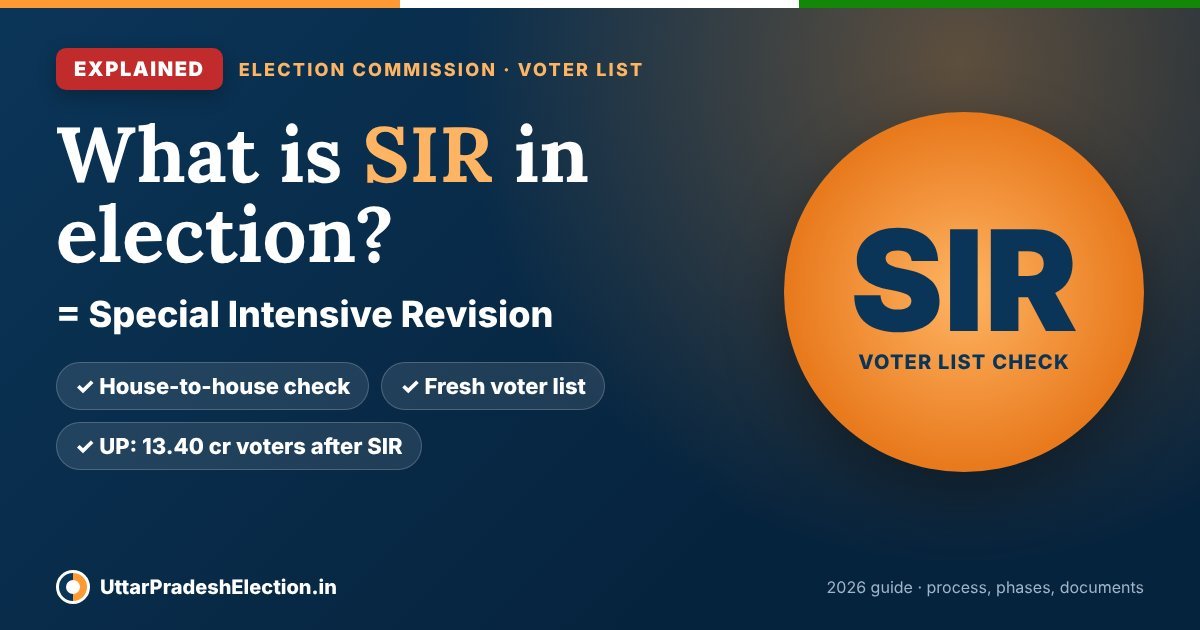
Quick answer: SIR in elections means Special Intensive Revision of the electoral rolls. It is a fresh, door-to-door re-verification of every voter, carried out by Booth Level Officers (BLOs) on the orders of the Election Commission of India (ECI). Unlike the routine yearly update, every elector has to be accounted for again — and names that cannot be verified are dropped from the draft list.
If you live in Uttar Pradesh, you have already been through an SIR: a BLO probably came to your house in late 2025 with a pre-filled form, and the state's voter list was rebuilt from those forms. The exercise has since been rolled out across most of India. This guide explains what SIR is, why the Election Commission does it, how it works step by step, and what it means for you before the 2027 elections.
What does SIR mean in an election?
An electoral roll — the voter list — has to be kept accurate: people die, move house, turn 18 or get registered twice. India updates the roll every year through a light-touch Special Summary Revision (SSR), where voters themselves apply to add, delete or correct entries. An intensive revision is the opposite approach: instead of patching the old list, the Election Commission has officials visit every household and prepare the list again from scratch, verifying each person.
The word special means it is ordered for a particular time or area rather than as part of the normal yearly cycle. Before 2025, most states last had an intensive revision around 2002–2004.
Why does the Election Commission conduct SIR?
- Remove dead voters whose names were never deleted.
- Remove shifted voters who moved permanently and may be registered at two places.
- Remove duplicate entries — the same person listed twice.
- Add eligible people who were missing, including young first-time voters.
- Check eligibility — that each person is an Indian citizen, 18 or older and ordinarily resident at the address.
The legal basis
SIR is carried out under Section 21(3) of the Representation of the People Act, 1950, which lets the Election Commission order a special revision of the roll for any constituency at any time, read with Article 324 of the Constitution, which gives the Commission control over the preparation of electoral rolls. On 27 May 2026, the Supreme Court (Chief Justice Surya Kant and Justice Joymalya Bagchi) dismissed the challenges to Bihar's SIR and held that it was traceable to these provisions. The Court also said that while the Commission can make a limited inquiry into citizenship for enrolment, formal decisions on citizenship belong to the competent authority under the Citizenship Act.
How SIR works: step by step
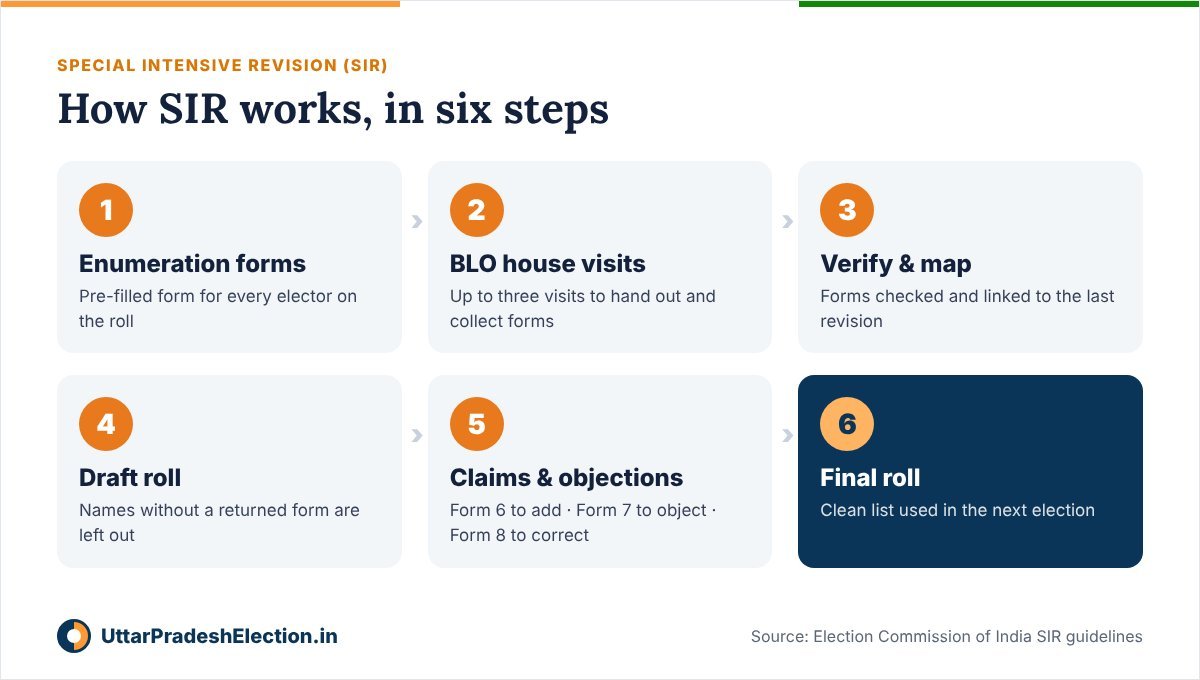
- Enumeration forms: Every elector on the existing roll gets a pre-filled enumeration form with their details.
- House-to-house visits: BLOs visit each house — up to three times if needed — to hand out and collect the forms. Political parties' Booth Level Agents (BLAs) can assist.
- Verification and mapping: Each returned form is checked and, where possible, linked to the person's (or their parents') entry in the last intensive revision.
- Draft roll: A draft list is published. Anyone whose form was not returned — because they died, moved, could not be found or were duplicates — is left out.
- Claims and objections: For about a month, people can apply to get their name included (Form 6), object to a wrong entry (Form 7) or correct details (Form 8). Electoral Registration Officers (EROs) issue notices and hear cases.
- Final roll: The cleaned-up final electoral roll is published and becomes the list used in the next election.
SIR vs SSR: what's the difference?
| SIR (Special Intensive Revision) | SSR (Special Summary Revision) | |
|---|---|---|
| How often | Occasionally, when the ECI orders it | Every year |
| Method | Door-to-door enumeration of every elector | Existing roll updated through applications |
| Who has to act | Every elector must return an enumeration form | Only people who want a change apply |
| Result | A freshly prepared roll | The old roll with additions, deletions and corrections |
| Example | UP, Nov 2025 – Apr 2026 | 17 states/UTs, Nov 2026 – Jan 2027 |
In a year in which SIR has been conducted, no SSR is held. That is why the Election Commission has ordered an SSR from 2 November 2026 in 17 states and UTs, including Uttar Pradesh, with 1 January 2027 as the qualifying date — draft roll on 12 November, claims until 11 December and final roll on 4 January 2027.
SIR in India: the three phases
| Phase | Where | Announced | Final rolls |
|---|---|---|---|
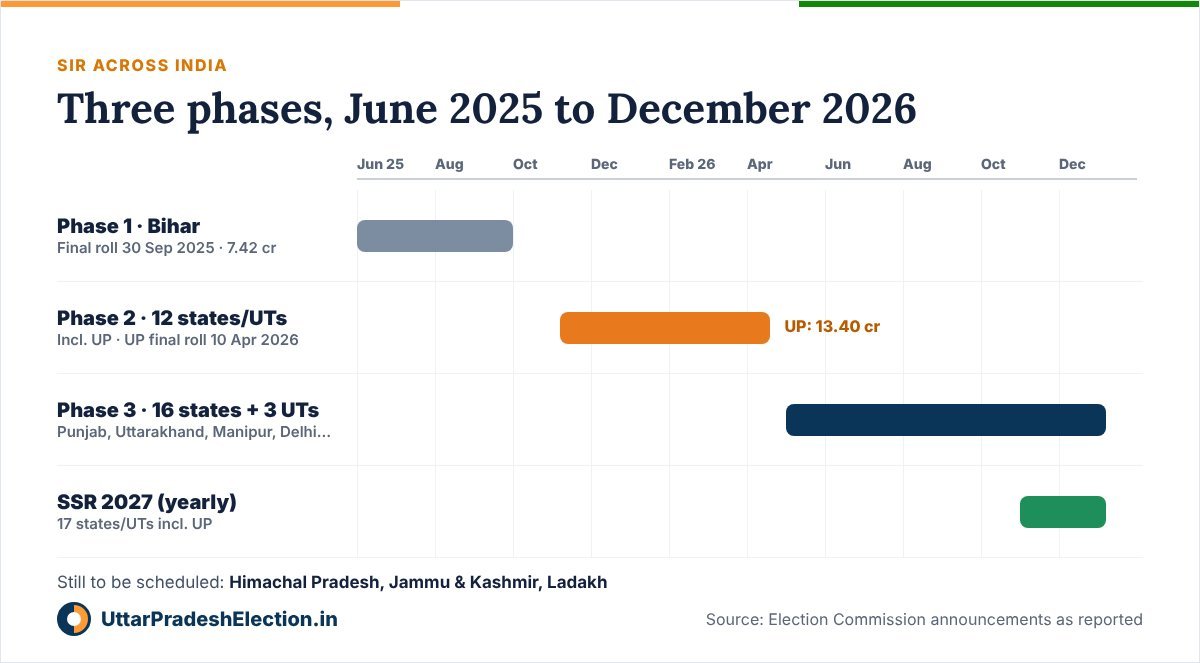
| Phase 1 | Bihar | 24 June 2025 | 30 September 2025 — 7.42 crore electors, down from about 7.89 crore |
| Phase 2 | 12 states/UTs: Uttar Pradesh, West Bengal, Tamil Nadu, Kerala, Gujarat, Rajasthan, Madhya Pradesh, Chhattisgarh, Goa, Puducherry, Andaman & Nicobar Islands, Lakshadweep | 27 October 2025 | Early 2026; UP's on 10 April 2026 |
| Phase 3 | 16 states and 3 UTs, including Punjab, Uttarakhand, Manipur, Maharashtra, Karnataka, Delhi and Haryana — about 36.73 crore electors | 14 May 2026 | September to December 2026, state by state |
Himachal Pradesh, Jammu & Kashmir and Ladakh were left out of Phase 3; the Commission said their schedule would be announced later. Phase 3 also had staggered dates — Punjab's final roll came in October 2026, and Tripura's is due in December 2026.
What SIR changed in Uttar Pradesh
| Stage | Electors |
|---|---|
| Roll before SIR | 15,44,30,092 |
| Draft roll, 6 January 2026 | 12,55,56,025 — about 2.89 crore entries dropped (46.23 lakh dead, 2.17 crore not found by BLOs, 25.47 lakh duplicates) |
| Final roll, 10 April 2026 | 13,39,84,792 — 84,28,767 more than the draft |
The net reduction of about 2.05 crore names — roughly 13% — makes it one of the largest voter-list clean-ups in the country. The gender ratio on the final roll is 834 women per 1,000 men, and 17,63,360 voters are aged 18–19. If you voted in 2022 or 2024 but did not return your enumeration form, your name may no longer be on the list — check it here.
Documents accepted during SIR
When a voter cannot be linked to the earlier roll, the ERO can ask for proof. The Election Commission's list includes:
- Identity card or pension order issued to a central or state government or PSU employee or pensioner
- Any identity card or document issued by a government, bank, post office, LIC or PSU before 1 July 1987
- Birth certificate
- Passport
- Matriculation or other educational certificate from a recognised board or university
- Permanent residence certificate
- Forest rights certificate
- OBC, SC or ST caste certificate
- National Register of Citizens entry (where it exists)
- Family register prepared by the state or local authority
- Land or house allotment certificate issued by the government
- Aadhaar — accepted as a twelfth document for identity after the Supreme Court's September 2025 direction, though it is not proof of citizenship
Criticism and the Supreme Court
Opposition parties and civil-society groups argued that SIR put the burden of proof on voters and could exclude poor, migrant and rural citizens who lacked documents. During the Bihar hearings, the Supreme Court pushed the Commission to accept Aadhaar, EPIC and ration cards. In its May 2026 verdict, the Court upheld the exercise but required that people whose citizenship the Commission doubts be referred to the competent authority, and that wrongly deleted residents can challenge their deletion.
What SIR means for you before 2027
- Check your name on the final roll at voters.eci.gov.in or electoralsearch.eci.gov.in.
- If it is missing, apply with Form 6 during the ongoing revision (claims until 11 December 2026) — see our Form 6 guide.
- If details are wrong, use Form 8.
- Read our simple guides: SIR election kya hai and SIR ka full form.
Frequently asked questions
SIR is the Special Intensive Revision of electoral rolls — a door-to-door re-verification of every voter by Booth Level Officers, after which a fresh voter list is published.
Special Intensive Revision.
SIR re-checks every elector house to house and rebuilds the roll; SSR (Special Summary Revision) is the yearly update in which only people who want a change apply.
Yes. UP's SIR ran from November 2025; the draft roll came on 6 January 2026 and the final roll on 10 April 2026, with 13,39,84,792 electors.
Yes, as a document of identity — the Supreme Court directed the Election Commission to treat it as a twelfth document — but Aadhaar is not proof of citizenship.
Section 21(3) of the Representation of the People Act, 1950, read with Article 324 of the Constitution.
Sources & official links
- Legal Republic — Supreme Court upholds Bihar SIR (ADR v. ECI, 27 May 2026)
- News On AIR — SIR Phase 2 in 12 states and UTs
- News On AIR — ECI announces SIR Phase III across 16 states and three UTs
- Scroll — Phase III schedule and qualifying dates
- News On AIR — UP electorate after SIR
- India TV — UP final voter list after SIR
- The Tribune — Special Summary Revision in 17 states from 2 November 2026
- The Federal — Aadhaar as the 12th document