What Is a Mock Parliament? Meaning, Roles, Order of Business and How to Conduct One — Plus Why It Is in the News
A mock parliament is a role-play of a real Parliament sitting, with a Speaker, a Prime Minister, ministers and an Opposition following actual parliamentary rules. Here is what it means, who plays which role, the order of business, how to conduct one in a school or college, and why two very different 'mock parliaments' made news in Delhi this week.
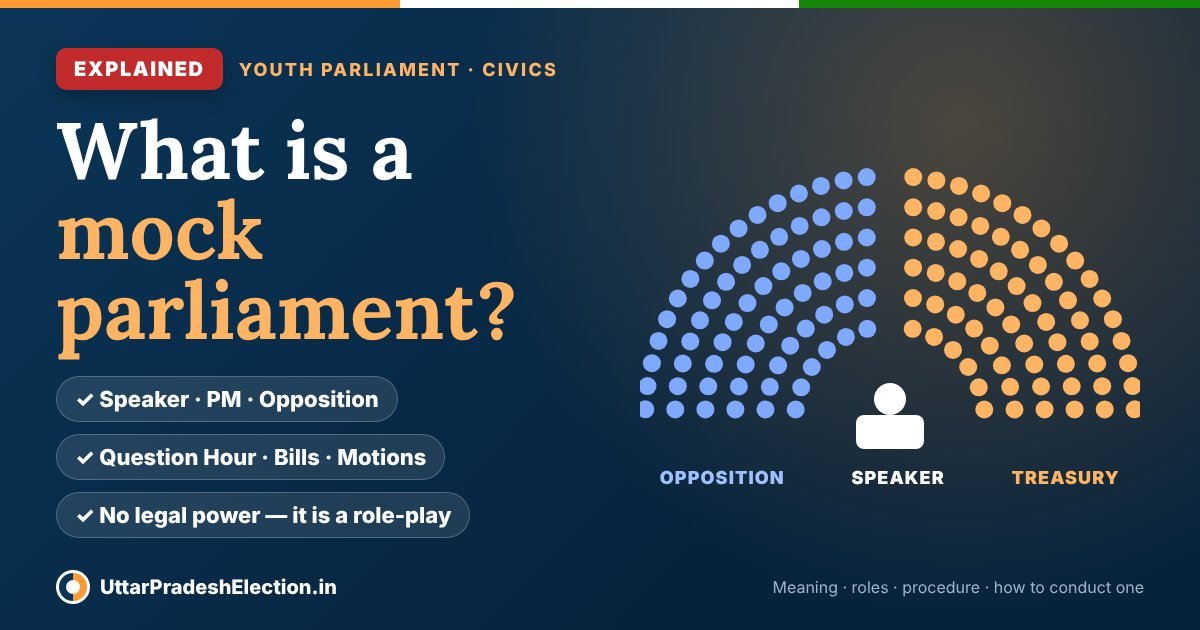
Quick answer: A mock parliament is a role-play of a real Parliament sitting. Participants act as the Speaker, the Prime Minister, ministers, the Leader of the Opposition and members, and they follow the actual rules of the House — asking questions, debating bills and voting on motions. It is used to teach how Parliament works, and sometimes by political parties as a form of symbolic protest. A mock parliament has no legal power: nothing it "passes" becomes law.
"Mock parliament" has been in the news this week for two very different reasons. On 30 October 2026, young people from across India gathered at the NDMC Convention Centre in New Delhi for a mock parliament on "Democracy vs Anarchy", organised by Citizens for Democracy, to experience how parliamentary debate works. A day later, on 31 October, the opposition INDIA bloc held a mock-parliament-style "public impeachment" of Chief Election Commissioner Gyanesh Kumar at Congress president Mallikarjun Kharge's residence. This guide explains what a mock parliament really is, how one is run, and what these events can and cannot do.
What does mock parliament mean?
"Mock" here means simulated, not "mocking". A mock parliament copies the structure and procedure of the Lok Sabha, the Rajya Sabha or a state Vidhan Sabha as closely as possible. Participants sit on Government (Treasury) and Opposition benches, address the Chair, and use real devices such as Question Hour, calling attention notices, adjournment motions and no-confidence motions. Schools and colleges call it a Youth Parliament; in Hindi it is called युवा संसद (youth parliament) or simply मॉक संसद.
Why are mock parliaments held?
- Civic education: to show how laws are made, how the Government is held accountable and why rules of debate matter.
- Skills: public speaking, research, listening, teamwork and leadership.
- Respect for dissent: participants learn to disagree within rules and accept the verdict of the House.
- Political protest: parties sometimes stage a "mock" or "people's" parliament when they cannot raise an issue in the real House — the proceedings are symbolic and have no legal effect.
The Youth Parliament scheme in India
The Ministry of Parliamentary Affairs has run Youth Parliament competitions for schools since the 1960s, starting in Delhi, and later extended them to Kendriya Vidyalayas, Jawahar Navodaya Vidyalayas and universities. In 2019, the President launched the web portal of the National Youth Parliament Scheme (NYPS), which lets institutions hold sittings on their own and upload them. Its upgraded version, NYPS 2.0, opened participation beyond recognised institutions to groups and individual citizens. By 27 January 2026, according to the Ministry's reply in the Lok Sabha, 4,432 institutions had registered and held 1,536 Youth Parliament sittings with 52,283 students, and in all 95,319 students and citizens had taken part.
Who plays which role?
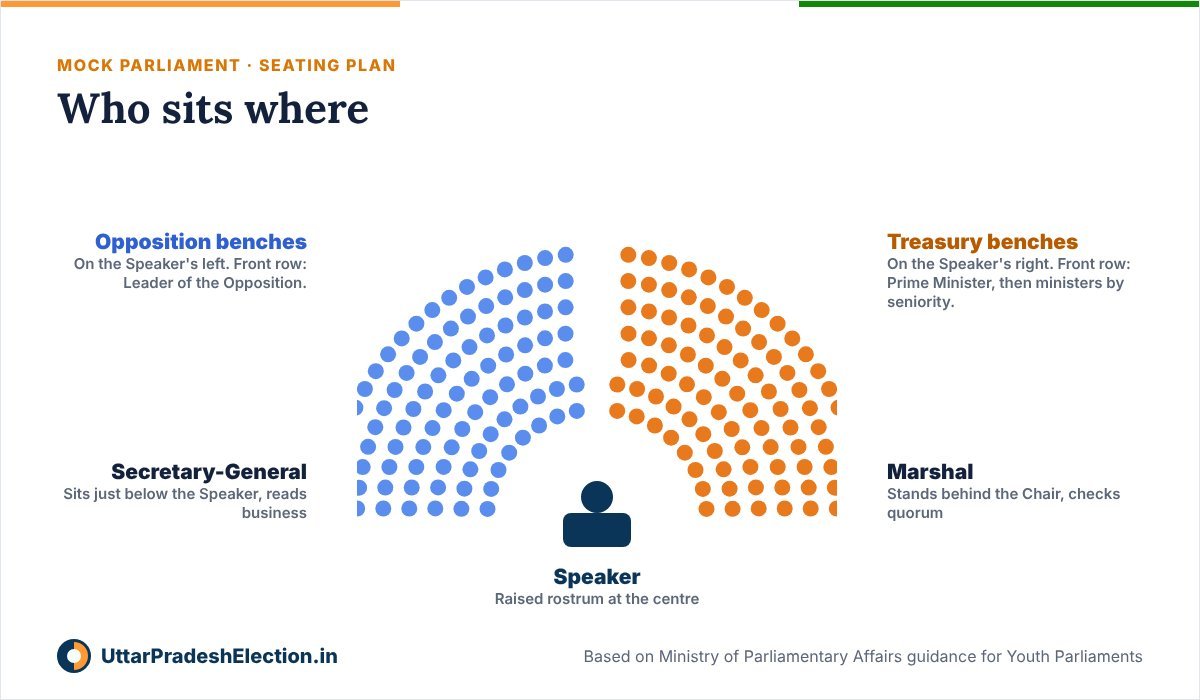
| Role | What the participant does |
|---|---|
| Speaker | Sits on the raised rostrum at the centre, conducts the sitting impartially, calls members to speak and puts motions to vote. |
| Prime Minister | Leads the Treasury benches from the first seat on the Speaker's right; replies on major issues. |
| Ministers | Sit next to the Prime Minister, answer questions and move or defend bills. |
| Leader of the Opposition | Leads the Opposition on the Speaker's left and moves motions such as no-confidence. |
| Members | Ask questions, raise urgent matters and take part in debate on both sides. |
| Secretary-General | Sits just below the Speaker, reads out business and handles papers. |
| Marshal | Announces the Speaker's arrival, checks quorum and stands behind the Chair throughout. |
Order of business in a mock parliament
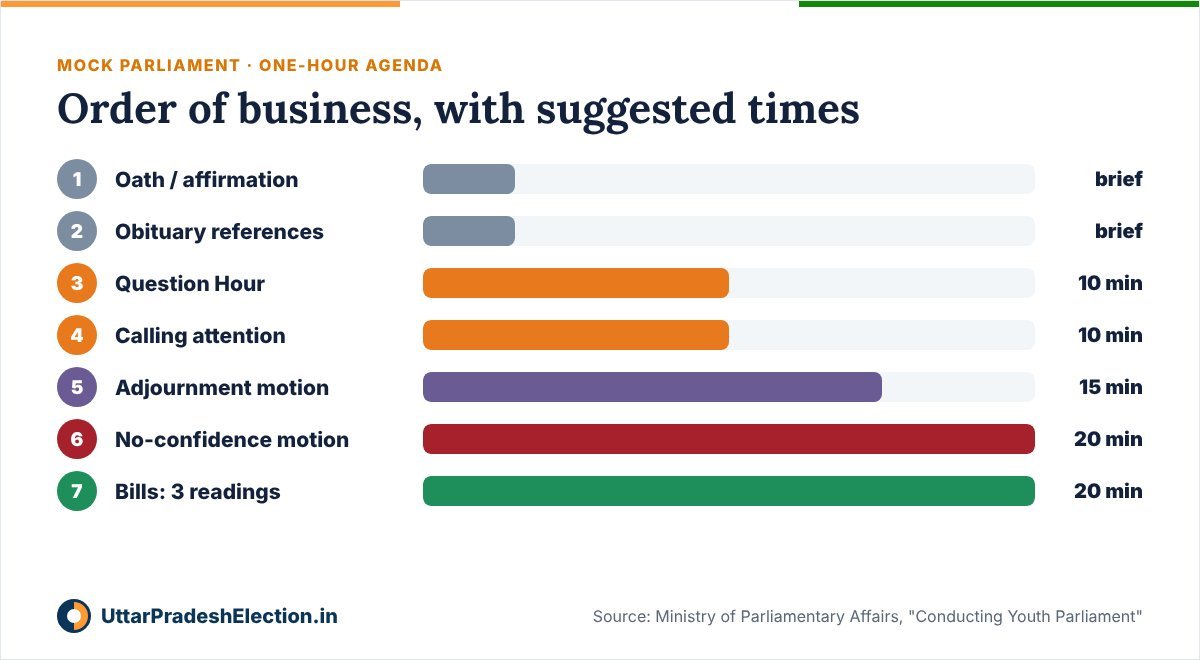
- Oath or affirmation by newly elected members.
- Obituary references — the Speaker announces, leaders speak and the House stands in silence.
- Question Hour (about 10 minutes) — members ask starred questions and ministers answer, with supplementaries.
- Papers laid on the Table.
- Calling attention notice (up to 10 minutes) on an urgent public matter.
- Adjournment motion (up to 15 minutes) — needs the Speaker's consent and the support of at least one-tenth of the House.
- No-confidence motion (up to 20 minutes) against the Council of Ministers.
- Legislative business (about 20 minutes) — a bill passes through first reading, second reading (debate) and third reading (passing).
The Ministry's guidance suggests keeping the whole sitting to about an hour, focusing on procedure and the quality of debate rather than costumes or caricature, and discouraging disorderly behaviour.
How to conduct a mock parliament in your school or college: 8 steps
- Pick a teacher-in-charge and a team of 40–60 students.
- Choose topics — for example voter-list revision, youth unemployment, road safety, online safety or a model bill such as "The Clean Campus Bill".
- Assign roles by debating ability and subject knowledge, and give girls and boys an equal chance.
- Research — let students gather facts and prepare questions, answers and speeches.
- Write a script for each item, while leaving room for spontaneous debate.
- Set up the hall in a horseshoe: Speaker in the centre, Treasury benches on the right, Opposition on the left, with placards for key roles.
- Rehearse the order of business and the voting procedure.
- Hold the sitting, then discuss what students learnt. Institutions can register and upload sittings on the NYPS portal.
Mock parliament vs real Parliament
| Mock parliament | Real Parliament | |
|---|---|---|
| Members | Students, citizens or party workers playing roles | Elected MPs |
| Powers | None — purely educational or symbolic | Makes laws, approves budgets, can remove the Government |
| Rules | Copied from the Rules of Procedure | Constitution and the Rules of Procedure of each House |
| Outcome | Learning or a political message | Binding decisions |
The INDIA bloc's 'mock impeachment' of the CEC
On 31 October 2026, opposition parties held what they called a "public impeachment" of Chief Election Commissioner Gyanesh Kumar at 10 Rajaji Marg, New Delhi. It was originally set for 30 October and was postponed because of rain. Former Lok Sabha Speaker Meira Kumar presided, and Congress president Mallikarjun Kharge moved the motion, accusing the CEC of running the Commission at the Government's behest and attacking the Special Intensive Revision of voter lists. Leaders said a real removal motion would be moved in the Rajya Sabha. The event was followed by a rally at Ramlila Maidan on 1 November. The BJP dismissed it — its MP Sudhanshu Trivedi said the Congress had organised a mock Parliament "to soothe its troubled prince".
Like every mock parliament, this one has no legal effect. A CEC can only be removed by Parliament itself, in the same way as a Supreme Court judge. Read what impeachment means and how a CEC can be removed.
Frequently asked questions
A role-play of a real Parliament sitting in which participants act as the Speaker, Prime Minister, ministers, Opposition and members and follow real parliamentary procedure.
To teach how Parliament works and to build public speaking, research and debating skills. Political parties also use mock parliaments as symbolic protests.
A participant playing the Speaker (or the Chairman, if it copies the Rajya Sabha), who conducts the sitting impartially.
No. Resolutions or "impeachments" passed in a mock parliament have no legal effect.
A Ministry of Parliamentary Affairs scheme and web portal through which educational institutions, groups and individuals can hold and register Youth Parliament sittings.
On 31 October 2026, former Speaker Meira Kumar chaired a symbolic "public impeachment" of CEC Gyanesh Kumar, and Mallikarjun Kharge moved the motion. It has no legal effect; the parties said a formal motion would be moved in the Rajya Sabha.
Sources & official links
- ANI — Mock Parliament on 'Democracy vs Anarchy' in New Delhi on 30 October
- Ministry of Parliamentary Affairs — Conducting Youth Parliament (guidance)
- PIB — Upgraded National Youth Parliament Scheme portal (NYPS 2.0)
- PIB — President launches the NYPS web portal
- The Week — INDIA bloc's 'public impeachment' of the CEC
- Free Press Journal — INDIA bloc holds public 'impeachment proceedings'
- ANI — BJP's Sudhanshu Trivedi on the mock Parliament