What Does Impeachment Mean? Can the Chief Election Commissioner Be Impeached? The Law, the Numbers and the Case Against CEC Gyanesh Kumar
Impeachment means a legislature formally charging a high official and voting to remove them. In India, the Chief Election Commissioner can be removed only like a Supreme Court judge — for proved misbehaviour or incapacity, by a special majority in both Houses. Here is what the word means, how the process works, and where the opposition's moves against CEC Gyanesh Kumar stand.
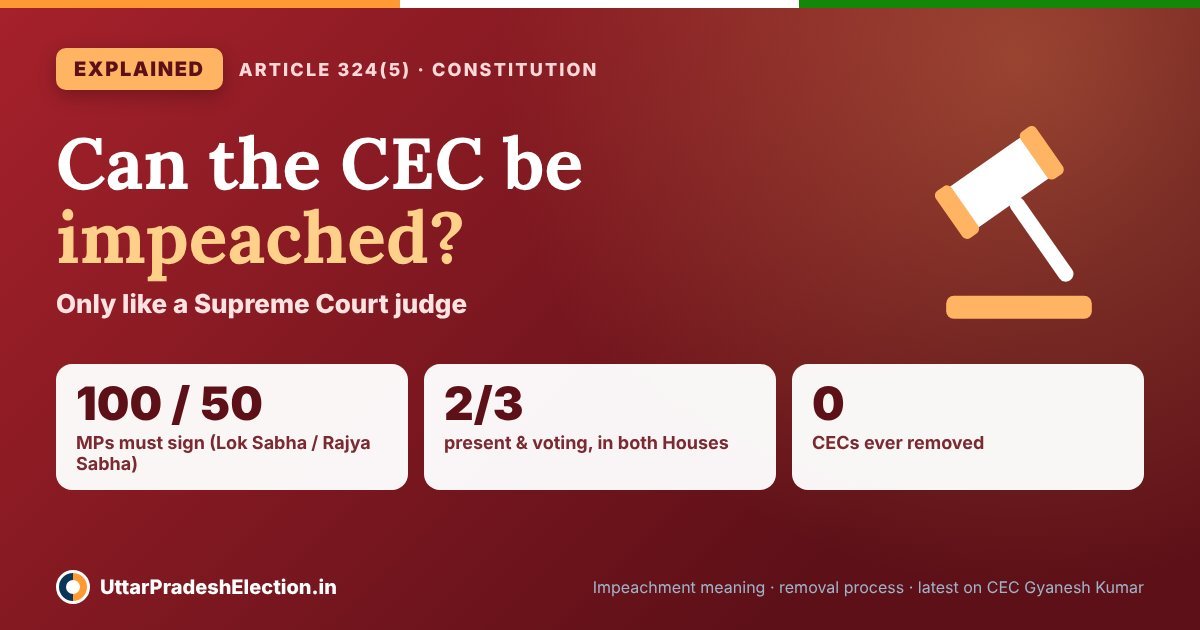
Quick answer: Impeachment means a legislature formally bringing charges against a high public official and voting on whether to remove them from office. In India, the word is used in the Constitution only for the President. The Chief Election Commissioner (CEC) can be removed only "in like manner and on the like grounds as a Judge of the Supreme Court" — that is, for proved misbehaviour or incapacity, by a special majority in both Houses of Parliament. This is commonly called impeachment. No CEC has ever been removed this way.
The phrase "impeachment of CEC" is in the news because opposition parties have been trying to remove Chief Election Commissioner Gyanesh Kumar. Two notices were rejected in April 2026, a third is pending in the Rajya Sabha, and on 31 October 2026 the INDIA bloc staged a symbolic mock-parliament-style "public impeachment" in Delhi. Here is what impeachment actually means, how the law works for the CEC, and why removal is so hard.
What does impeachment mean?
The word comes from an old French verb meaning "to hinder" or "to impede". In modern constitutions, impeachment is a quasi-judicial process run by the legislature: one body brings charges, an inquiry or trial examines them, and the official is removed only if a large majority agrees. It exists to make powerful officials who cannot simply be dismissed — such as a President or a judge — accountable for serious wrongdoing, while protecting them from removal for political reasons.
In the United States, for example, the House of Representatives impeaches (charges) by a simple majority, and the Senate holds the trial, where a two-thirds vote is needed to convict. Presidents Andrew Johnson, Bill Clinton and Donald Trump (twice) were impeached by the House; none was convicted by the Senate.
Impeachment in India: who can be removed, and how
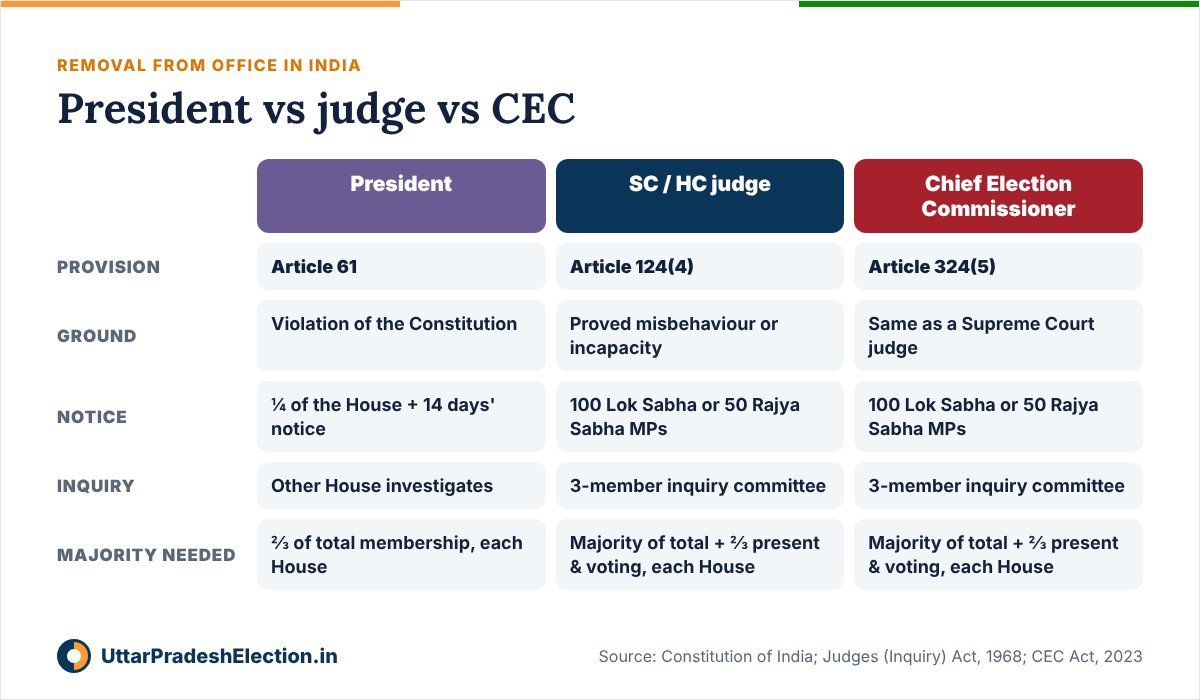
| President | Supreme Court / High Court judge | Chief Election Commissioner | |
|---|---|---|---|
| Provision | Article 61 (called "impeachment") | Article 124(4) / 217, Judges (Inquiry) Act, 1968 | Article 324(5); Section 11 of the CEC Act, 2023 |
| Ground | Violation of the Constitution | Proved misbehaviour or incapacity | Same as a Supreme Court judge |
| Notice | Signed by at least one-fourth of the House; 14 days' notice | 100 Lok Sabha MPs or 50 Rajya Sabha MPs | Same as a judge |
| Inquiry | The other House investigates the charge | Three-member committee | Same as a judge |
| Majority | Two-thirds of total membership of each House | Majority of total membership and two-thirds of those present and voting, in each House | Same as a judge |
| Ever used? | Never | Motions moved, but no judge removed | Never |
Strictly speaking, the Constitution uses "impeachment" only for the President. For judges and the CEC it speaks of removal by an "address" of Parliament to the President. In everyday language, all three are called impeachment.
How a CEC can be removed: step by step
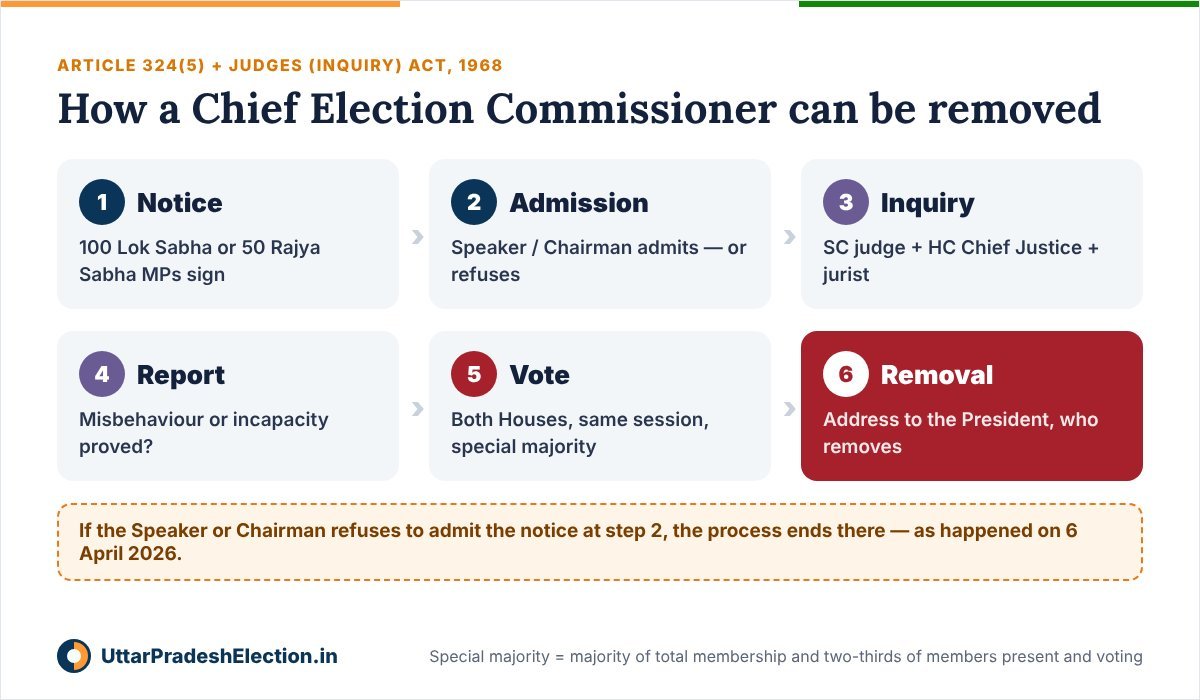
- Notice of motion: at least 100 Lok Sabha MPs or 50 Rajya Sabha MPs sign a notice listing the charges of misbehaviour or incapacity.
- Admission: the Speaker or the Chairman may admit the motion or refuse it after considering the material. Refusal ends the process.
- Inquiry committee: if admitted, a three-member committee — a Supreme Court judge, a High Court Chief Justice and a distinguished jurist — investigates and frames charges. The official can defend himself.
- Report: if the committee finds no misbehaviour or incapacity, the motion goes no further.
- Vote: if the charges are proved, the motion must be passed in both Houses, in the same session, by a majority of the total membership and two-thirds of members present and voting.
- Removal: an address is presented to the President, who orders the removal.
In numbers, with full Houses, that means at least 272 of the Lok Sabha's 543 seats and at least 123 of the Rajya Sabha's 245 — and two-thirds of those voting. The opposition does not have these numbers on its own in either House, which is why removal of a CEC has never succeeded.
Election Commissioners are protected differently
The two other Election Commissioners can be removed only on the recommendation of the CEC. The best-known case came in January 2009, when CEC N. Gopalaswami recommended the removal of Election Commissioner Navin Chawla; the Government did not accept it, and Chawla later became CEC himself.
The case against CEC Gyanesh Kumar: timeline
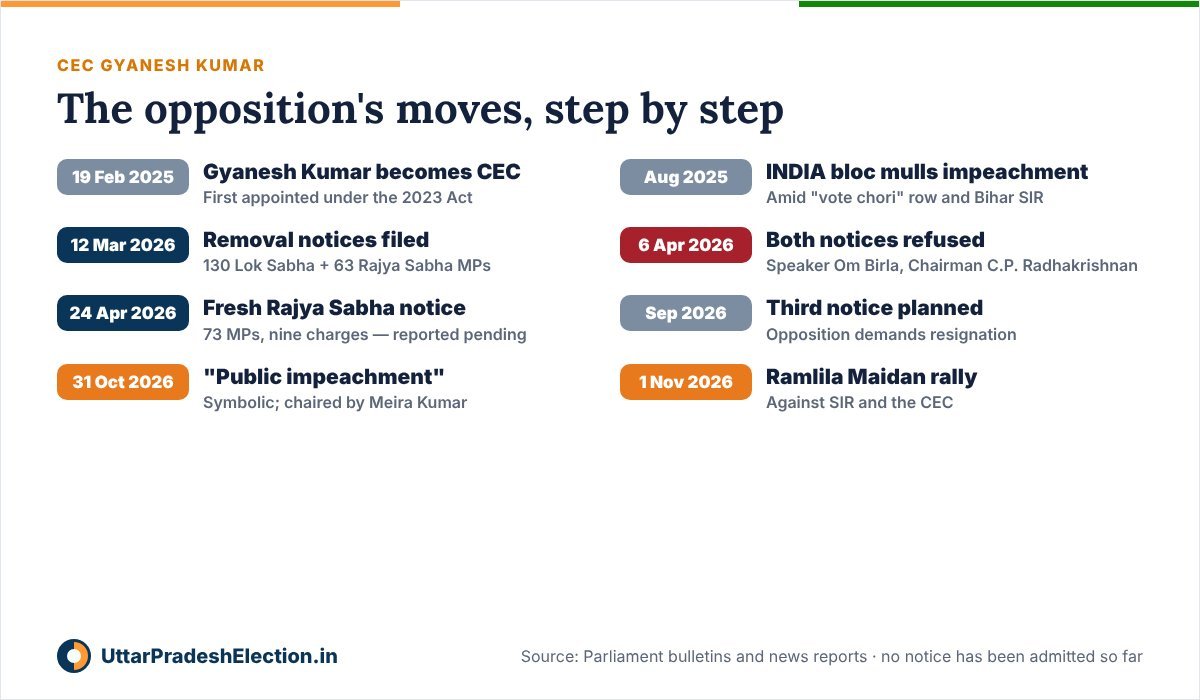
| Date | What happened |
|---|---|
| 19 February 2025 | Gyanesh Kumar becomes CEC — the first appointed under the CEC Act, 2023. |
| August 2025 | Amid the "vote chori" allegations and Bihar's SIR, the INDIA bloc says it is considering an impeachment motion. |
| 12 March 2026 | Opposition MPs submit removal notices: 130 signatures in the Lok Sabha and 63 in the Rajya Sabha, alleging misbehaviour. |
| 6 April 2026 | Lok Sabha Speaker Om Birla and Rajya Sabha Chairman C. P. Radhakrishnan refuse to admit both notices under Section 3 of the Judges (Inquiry) Act. |
| 24 April 2026 | 73 Rajya Sabha MPs file a fresh notice with nine charges, including "partisan" enforcement of the Model Code, the West Bengal SIR and adverse court observations. It has been reported as pending. |
| September 2026 | After a newspaper investigation reported friction among the commissioners, the opposition says it will file a third notice and demands the CEC's resignation. |
| 31 October 2026 | The INDIA bloc holds a symbolic "public impeachment", chaired by former Speaker Meira Kumar, with Mallikarjun Kharge moving the motion. |
| 1 November 2026 | Opposition rally at Ramlila Maidan against the SIR and the CEC. |
The Election Commission has denied allegations of bias, and BJP leaders have dismissed the opposition's campaign as political drama. None of the allegations has been tested by an inquiry committee, because no notice has yet been admitted.
What does the "public impeachment" change?
Legally, nothing. A mock or "people's" impeachment is a political protest; it cannot remove anyone. Only a motion admitted in Parliament and passed by both Houses can. Its importance is political: it keeps the SIR and the Election Commission's conduct in the headlines ahead of the 2027 Assembly elections in Uttar Pradesh and six other states.
Key terms
- Proved misbehaviour: wrongful conduct established through the inquiry process — not just an allegation.
- Incapacity: physical or mental inability to do the job.
- Address: a formal message from both Houses to the President asking for removal.
- Special majority: a majority of the total membership plus two-thirds of members present and voting.
Frequently asked questions
A formal process in which a legislature brings charges against a high official and votes on whether to remove them from office.
Yes, in effect. Under Article 324(5) and Section 11 of the CEC Act, 2023, the CEC can be removed only in the same manner and on the same grounds as a Supreme Court judge — proved misbehaviour or incapacity — by a special majority in both Houses.
At least 100 Lok Sabha MPs or 50 Rajya Sabha MPs must sign the notice.
No. No Chief Election Commissioner — and no Supreme Court or High Court judge — has ever been removed by Parliament.
On 6 April 2026, the Lok Sabha Speaker and Rajya Sabha Chairman refused to admit them under Section 3 of the Judges (Inquiry) Act after considering the material, without giving detailed public reasons.
No. The INDIA bloc held a symbolic "public impeachment", which has no legal effect. Removal is possible only through Parliament.
The President, but only on the recommendation of the Chief Election Commissioner.
Sources & official links
- DD News — Speaker and Chairman reject notices against the CEC
- News On AIR — Notices of motion against CEC rejected
- The Wire — 73 MPs move fresh notice with nine charges
- The Wire — Opposition mulls a fresh notice
- ThePrint — INDIA bloc's 'public impeachment' postponed to Saturday
- Siasat — INDIA bloc holds CEC's 'public impeachment'
- Wikipedia — Gyanesh Kumar